

Laptop repairability rankings for 2026 reveal that Apple and Lenovo are far from leading the pack. The latest report from the consumer advocacy group Public Interest Research Group (PIRG) Education Fund highlights significant issues with the repairability of devices from these manufacturers.
In its report titled “Failing the Fix (2026): Grading laptop and cell phone companies on the fixability of their products,” PIRG evaluated the 10 newest laptops and smartphones available in January 2026 through manufacturers’ French websites. The French repairability index, a grading system for device repairability, was used as a benchmark. This index is mandatory for products sold in France and is advocated for wider adoption by right-to-repair groups.
PIRG modified the French index to place greater emphasis on the ease of disassembling products, a factor they believe consumers prioritize when considering repairability. Additional criteria included the availability of repair documentation, spare parts, and affordability of those parts.
The report also penalized companies for their membership in industry groups that oppose right-to-repair legislation, such as TechNet and the Consumer Technology Association. Conversely, companies supporting right-to-repair legislation received bonus points.
Let’s dive into the laptop repairability rankings with a detailed look at the findings.
Laptop Repairability Rankings
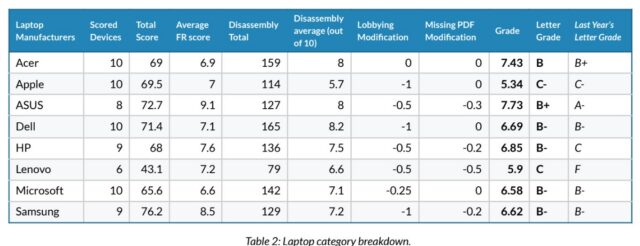
Apple received the lowest grades in both laptop and smartphone repairability, with a C-minus for laptops. The company’s poor disassembly scores and membership in TechNet and the CTA contributed to its low ranking. Apple’s MacBook Neo, however, shows potential for improvement in future models.
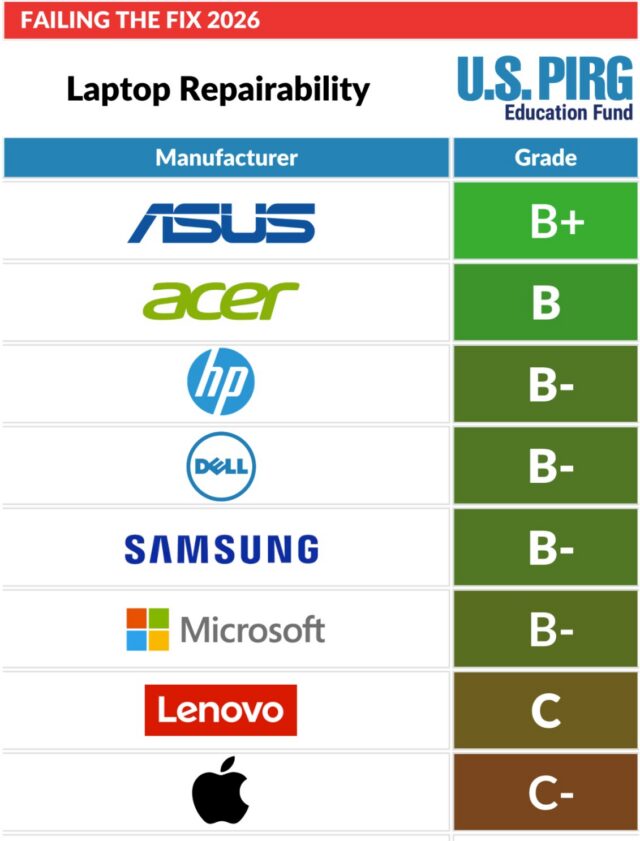
Lenovo followed closely behind with a C-minus, also struggling with disassembly scores. Additionally, Lenovo lost points for not fully complying with French regulations regarding the availability of repair score PDFs. Despite some improvements, the company still faces issues meeting consumer expectations for repairability.
Phone Repairability Rankings
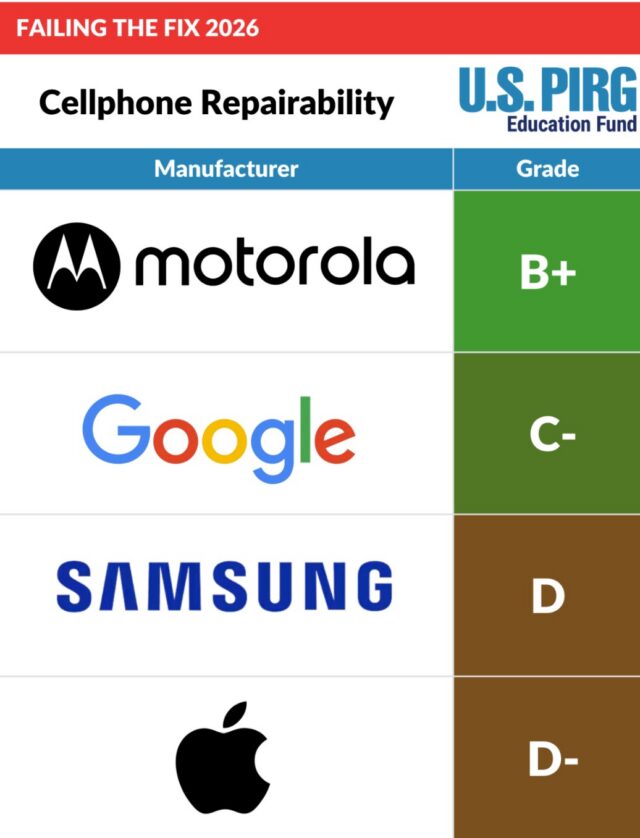
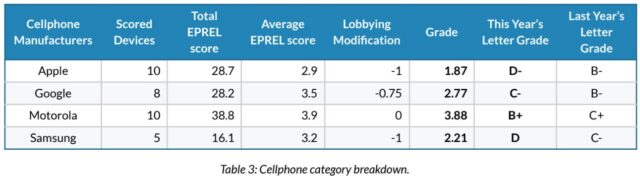
For smartphones, Lenovo’s Motorola brand topped the chart, while Apple and Samsung scored poorly. The European Product Registry for Energy Labelling (EPREL) criteria, introduced in June 2025, evaluated smartphones based on factors like disassembly depth, spare part availability, and software updates. Apple’s progress in moving away from parts pairing and introducing the Repair Assistant was noted, but challenges remain with third-party Face ID replacements and software restrictions.
Apple’s Activation Lock anti-theft feature, extended to individual parts, poses another hurdle for the repair ecosystem. This issue is not unique to Apple; parts pairing and software restrictions are industry-wide problems affecting consumers and independent technicians.
Room for Improvement
While the laptop repairability rankings indicate stagnation across many popular brands, there are signs of progress. Consumers now have better access to parts, tools, and information from vendors. However, improvements in ease of disassembly take longer to implement. Vendors are also releasing more repairable designs, as seen with Apple’s MacBook Neo.
Proctor believes that the repairability landscape is evolving but still faces significant challenges. The industry’s focus on parts pairing and software restrictions needs to be addressed to truly enhance device repairability.
As consumers demand more sustainable and repairable products, it is crucial for manufacturers to prioritize these aspects. The laptop repairability rankings serve as a wake-up call for companies like Apple and Lenovo to make significant strides in this area.
For more insights into the repairability of tech products, check out the full report from [PIRG Education Fund](https://pirg.org/edfund/resources/failing-the-fix-2026/) for detailed findings and recommendations.
To learn more about the French repairability index and its impact on consumer choices, visit the [EPREL website](https://joint-research-centre.ec.europa.eu/jrc-news-and-updates/new-eu-labels-help-consumers-choose-more-repairable-electronics-2025-06-20_en).
To explore the implications of parts pairing and software restrictions, read more about Apple’s [Repair Assistant](https://support.apple.com/en-us/120579) and the challenges faced by third-party Face ID replacements on [iFixit](https://www.ifixit.com/News/97100/apple-finally-promises-to-enable-third-party-parts-mostly).
For the latest developments in right-to-repair legislation, see the influence of big tech lobbyists on New York’s repair bill on [Ars Technica](https://arstechnica.com/tech-policy/2023/02/report-reveals-the-influence-big-tech-lobbyists-had-on-new-yorks-repair-bill/) and Apple’s lobbying efforts against right-to-repair on [Vice](https://www.vice.com/en/article/apple-is-lobbying-against-your-right-to-repair-iphones-new-york-state-records-confirm/).
For information on the 2025 laptop repairability rankings, see our [coverage here](https://arstechnica.com/gadgets/2025/02/macbooks-lagging-behind-pc-rivals-when-it-comes-to-repairability-report/ rel=”noopener”).
The information in this article is attributed to Scharon Harding, a senior technology reporter at Ars Technica, who specializes in news, reviews, and analysis of consumer gadgets and services.
Original source: Ars Technica




Leave a Reply